Thursday, March 6, 2014

Party time!

There’s been a new energy in Toktogul recently. It’s partially due to the fact that spring has maybe, finally come. It’s also because there has been a recent string of holidays, bringing everyone out of their homes and out of their winter glooms.

The first was Men’s Day (also known as “Defense of the Fatherland Day”) on February 23, the day on which men throughout the former Soviet Union are honored for their manliness. Coming up on March 8 is International Women’s Day, which recognizes the accomplishments and struggles of women worldwide. And thrown in the mix, on March 5, is “Ak Kalpak Day,” a celebration of the traditional Kyrgyz men’s hat. My sitemate Max and I hypothesize that the purpose of this holiday is to make sure men have more holidays than women.

People in Kyrgyzstan take holidays quite seriously. They often involve “guesting,” visiting others’ homes for hours of chai and food and conversation. People also go out to cafes for holidays, where they feast and dance and make merry.

I try to attach myself to a Kyrgyz friend for these holidays, so as to get the full experience. And no one in my life knows how to celebrate better than Satina-eje, a 60-year-old English teacher who has taken Max and me under her wing.

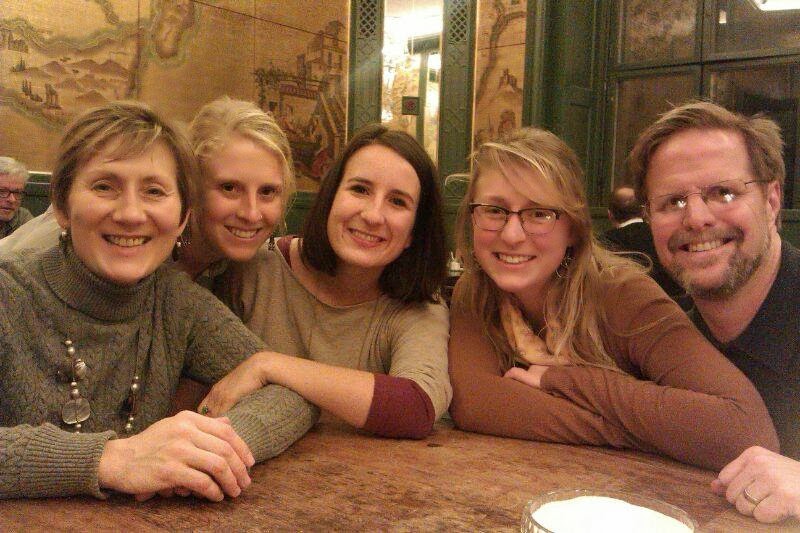
So yesterday, in honor of Women’s Day, I went to a café with Satina-eje and the other teachers from her school. I’ve been to many such parties, and I’ve learned a lot—the most important lesson being that Kyrgyz women can out-eat, out-drink and out-dance me any day of the week, so it’s not even worth trying to keep up.

Satina and I arrived to the party a little early. Correction: we arrived on time, which means no one else showed up for almost an hour. We drank chai and she caught me up on the latest Toktogul gossip, while some of the younger schoolteachers prepared the feast. In the usual style, the table was spread with bread, borsok (tiny friend breads), a variety of salads, fruits, candies, cookies and a few bottles of vodka.

The guests trickled in, nearly all women. The ladies dove into the spread, and every once in a while one of them would pause from their eating-drinking-talking long enough to dump more potato salad on my plate or sprinkle a fistful of borsok in my direction. Having learned from previous experiences, I paced myself on food and tea. If I ate at the same rate as the women around me (or ate at the rate they were urging me to eat) I knew I wouldn’t even make it to the first course. 

The master of ceremonies was a guy named Bakit, who is a teacher of some kind and a frequent party emcee in Toktogul. In the typical Kyrgyz style, he invited several people at a time up to the front to give toasts. The toasts went something like this: “Dear teachers, you are beautiful and strong. I congratulate you on Women’s Day and wish you good health and good luck.” Everyone in the audience listened carefully and nodded solemnly, and then the microphone was passed on to the next person, who proceeded to give an identical speech. This happens at every Kyrgyz party—everyone gets their chance to speak, and everyone says some slight variation of the exact same thing.

The soup course came out, everyone at my table took a few vodka shots  (toasts were given to the hope that I may find a husband this year), and then it was time to DANCE. Kyrgyz people are very into dancing. As far as I can tell, the same two Kyrgyz pop songs and two Russian pop songs are usually played on repeat, but that is all that is needed. All the ladies got up to dance, and I was, of course, dragged along.

I used to be a little sheepish about dancing in situations like this, but I’ve come to embrace it as a time to test out dance moves I would be too embarrassed to try anywhere else. These moves usually go over very well with Kyrgyz people. I also try to do some low twists so as to get a good quad workout.

Soon enough, dancing faded into more toasts and preparations for the next course of food. I was feeling pretty beat. Plus, I’d overheard some women at my table talking about trying to make me sing a song in front of everyone. It seemed like a good time to make an exit. I’ve never actually made it to the end of a Kyrgyz party—I usually leave by the 5-hour mark—although I imagine things wrap up around the time the last vodka bottle is drained.


I left with the requisite plastic bag full of candies, bread and fruit (and even managed to grab the bag before someone dumped a chunk of sheep meat into it). It had been a fun party, and even though this Women’s Day celebration was more focused on dancing and vodka, and less focused on promoting women’s rights, I felt satisfied with it. Most Kyrgyz women spend the majority of their time serving, feeding, cleaning up after and caring for others. Giving these women a few hours to kick back and have fun seemed like a fine way to celebrate them.

Satina-eje (right) and her friend.

Decked-out table, pre-feasting.

Satina-eje, me and two teachers.

Ladies digging in.

I'm not the only one with cool moves.


Thursday, February 27, 2014

The Bride Kidnapping Post

I had spent a week trying to figure out how to write a post about bride kidnapping, when my host mother got a phone call over dinner. It was a friend, calling to say that another mutual friend had been bride kidnapped. It was joyous news, my host mother said.

I immediately began asking a lot of questions: “Is she happy about this?” “Is he a good man?” “Why did he kidnap her rather than just have a normal wedding?”

Seeing the concern on my face, my host parents broke it down for me: The bride and groom were boyfriend and girlfriend, and had acted out the ritual to hasten their nuptials, to avoid the costly pomp and circumstance of a traditional Kyrgyz wedding. “This is a good thing,” my host father said multiple times. “If they didn’t know each other, it would be bad.”

This is just another example in my life illustrating the complexity and frequency of bride kidnapping in Kyrgyzstan. After mentioning bride kidnapping in my most recent article for the Battle Creek Enquirer, I knew I wanted to write more about it. But, to be honest, I was nervous to do so. After ten months in Kyrgyzstan, I feel like I am still trying to figure out this practice. Additionally, anything I wrote would only represent my very limited view as a foreigner here. Nonetheless, I’m going to give it a try.

In its most basic definition, bride kidnapping is the practice of taking a woman for marriage against her will. Many Kyrgyz people maintain that it is an ancient tradition, and while it probably did occur in centuries past, it actually became more frequent during the Soviet period. This change was fueled by economic hardship and was perhaps a reaction to the changing (improving) status of women under Soviet rule.

One of the reasons bride kidnapping is so complex is that it comes in many forms. Some couples, like my host mother’s friends, act out a bride kidnapping in order to marry quickly and cheaply. Other times, women are bridekidnapped by men they do not know. Perhaps this man has little money or few prospects, perhaps he is a youngest son, meaning his wife will be duty-bound to take on the undesirable role of caretaker for his parents. Often enough, though, it seems to me that bride kidnappings occupy a middle ground—not consensual or planned, but committed by a boyfriend or acquaintance. However it happens, it’s estimated that about half of marriages in Kyrgyzstan are brought about by kidnapping.

As I understand it, this is how it usually works: a young man has his eye on a particular woman, and decides to make her his bride. He gathers together a group of his buddies, and they make a plan. Often, one of the young woman’s friends or relatives will play along, and bring the unwitting young woman to a certain place at a certain time. The young men roll up in a car, grab the girl and drive off. There are tears, efforts to break free, but the young woman doesn’t stand much of a chance. Once she is taken into the young man’s home, the women of the family take over. They tie a white scarf around her head and give her earrings, which symbolize marriage. If she’s still hell-bent on getting away, one of the oldest women will lay down in the doorway. To step over an elder is deeply shameful. As strange as it might seem to an American, this trick is often enough to keep the young woman from fleeing.

By the next morning, no matter what actually happens (though sexual assault is often committed) the young woman is presumed not to be a virgin. Kyrgyz culture places a high value on female viginity—the word for which is literally “girlhood,” with no male equivalent—and as such many women feel their fates are truly sealed at this point. In recent years, women’s shelters have been created in some larger cities in Kyrgyzstan, to help women who do chose to escape such marriages, though shelters like these aren’t accesible to many women. Some families will call the police, or go in themselves to rescue their daughter. But often enough, families will encourage her to stay. With her honor gone, what other prospects does she have?

Bride kidnapping is illegal here. Pressure from national and international organizations resulted in a 2013 law raised the penalty for bride kidnapping to 5-10 years’ prison time, about the same as the sentence for sheep theft. But very few bride kidnappings are reported to the police or taken to trial. Most women simply accept it. Some of them go on to lead happy, married lives. Others don’t. Every year, there are stories in the press about women who commit suicide after being bride kidnapped—and, likely enough, there are more such suicides that aren’t reported or publicized. Many marriages that begin with kidnapping end in divorce, a practice that is becoming more common in Kyrgyzstan, though still considered shameful.

One of the reasons that it has been difficult for me to understand bride kidnapping, is that Kyrgyz people often minimize it. People joke about bride kidnapping a lot—in my daily conversations about why I am not married at the ripe old age of twenty-three, these jokes come up all the time. If I really press the issue, they’ll acknowledge that bride kidnapping is bad, but they often follow up by saying that it doesn’t occur much anymore. Maybe it happens in rural villages, or in the far south, but mostly it’s a thing of the past. I hear this a lot, but it is hard for me to believe that bride kidnapping is a dying tradition, or something that’s okay to joke about. I know women who were kidnapped, I read about it in the news, my fellow volunteers have witnessed bride kidnappings, and, sometimes, my dinner is interrupted with news of such a marriage.


I accept that as a foreigner, a temporary resident of Kyrgyzstan, my perspective on bride kidnapping will never be complete. And maybe that can be a strength, my tool against this form of gender oppression. I can always play the “dumb American” card, I can ask a lot of questions, and let my facial expression show my disgust with bride kidnapping, and say “I don’t think it’s funny. I don’t think it’s okay.”  And maybe, as time goes on, I can convince a few more people to agree with me.

Me tying the traditional white "joluk" on a new bride at a wedding this past autumn.
This was NOT a bride kidnapping.

My students acting out bride kidnapping during one of our lessons.

Friday, February 14, 2014

On Valentine's Day

I was recently in a village outside of Toktogul for a meeting with leaders of local village health committees. I took my seat in the tiny room, packed to the brim with chairs and people, and an older man who I had met before sat down next to me. He leaned in close, and by way of greeting, said “Жигит таптынбы?”

“Have you found a man yet?”

I burst out laughing. I cannot possibly exaggerate the extent to which questions like this are a part of my daily life. Everyone wants to know if I’m married, if I have a boyfriend, when I will get married, why I am not married. A woman recently asked me if I had siblings, and when I said I had a younger sister, the woman asked, “Well, is she married?”

At some point, I think most volunteers here have to decide to either become incredibly bothered by the constant barrage of marriage questions, or to find the humor in it. I choose to find the humor in it, a stragegy I have successful utilized with many other small annoyances of life here (getting stuck in sheep-traffic jams and being served the delicacy of sheep’s eyeball at a party are examples that come to mind…..yeah, sheep are a big deal here).

I’ve been thinking about marriage and relationships a lot recently, not solely because of the slew of questions that I get on a daily basis, but because I’ve been having more conversations on the topic with locals. I’ve been using a rather liberal definition of the word “health” in the lessons I’ve been planning for my youth health group. We’ve talked about healthy and unhealthy relationships, gender issues, bride kidnapping and soon I plan to get into the even grittier topic of sex. It’s been really interesting to hear their perspectives and share my own perspectives with them.

The thing that has become abundantly clear is that teenagers here are not really so different from teenagers in the States. They are nervous and excited about the idea of having boyfriends and girlfriends. But apart from the prospect of having someone special to text and go to movies with and maybe steal a kiss from, they haven’t thought too much about what they want from relationships. They haven’t thought about the ways relationships can be harmful, too, the skewed power dynamics that can develop, particularly within this culture. I ask them if women are oppressed here, and they him and haw: “Maybe…” “No, but I think we are equal…” “Some women are….” These students have certainly seen and experienced gender oppression, but they don’t necessarily connect the dots between their experiences and the larger system. And so much of their energy is consumed with dreaming of and working towards their futures. They are too busy imagining all they can become to ruminate on the things that might hold them back.

I’ve also been having many relationship-related conversations with a friend of mine, who I’ll call Ainazik. Ainazik was bride-kidnapped about ten years ago, when she was in university. She didn’t finish her degree as a result, and now lives in Toktogul with her husband, three kids and mother-in-law. Ainazik loves her kids a lot—that is clear—but she has big problems with her husband, a guy who fits the Kyrgyz man stereotype of drinking, smoking, snoring and eating without working much or accomplishing anything. Her mother-in-law is emotionally abusive toward Ainazik, and always takes the side of the bum husband. The work of raising the family, earning money, caring for the mother-in-law and running the house falls soley on Ainazik. On top of that, she deals alone with the sorrow of having her dreams stolen from her the day she was bridekidnapped. Ainazink once said to me, of her husband, “at least he doesn’t beat me.” It was one of the most heartbreaking things anyone has said to me. That a woman should feel she is lucky to be in an emotionally barren relationship with a lazy man who at least doesn’t beat her is a pretty bleak picture.

I asked Ainazik if she thinks women are oppressed here. She didn’t skip a beat. “Yes.” For her, it’s not a theory. It’s her life story, her daily reality.

The contrast between my students and Ainazik is sobering. Ten years ago, Ainazik was one of them. I know she was a hardworking student, I know she is incredibly bright. Despite only finishing half of her university education, she speaks better English than nearly every English teacher I’ve met here. Just as my students view bride kidnapping and gender oppression as abstract ideas that probably won’t affect them, I’m sure Ainazik never imagined where she would end up.

I am very lucky, though, because I live with a host family that provides a daily example of how things could be different. This week, my host mother Asel has been in the south preparing to take an exam that will mark the completion of her finance degree. My poor host father, Uchan, has been nearly beside himself with loneliness, missing her and the baby, shuffling around the house and cooking bizarre potato concoctions for himself. This morning, Uchan and I ate breakfast together, and I reminded him that it’s Valentine’s Day. “Maybe you should call Asel,” I said, “And tell her you love her.” He thought about for a minute, then said he would call her. “But you know,” he said, “I tell her that every day.”

Happy Valentine’s Day, everyone.

Uchan with Bekbolot, one of the loves of his life.

Father and son.

Me and MY Valentines, all 19 of them.

Uchan, Asel and Bekbolot: a family portrait from a few months ago.
Teaching about healthy relationships on Valentine's Day
...and a classic Britta expression.

Thursday, January 30, 2014

Жаны Жылыныздар Менен!

On this last day of the first month of new year, I thought I’d take the time to wish everyone a happy 2014! I’ve been a bad blogger of late, but only because my life has here has been its busiest yet. Thanks to warm socks and lots of hot tea, I am surviving the winter, working a lot and continuing to enjoy my time in Kyrgyzstan.

I went to Munich and Prague over the holidays, and got to see some fantastic people, including my Mom n’ Pop, my sister Anna, K College friends Milo, John and Laurel, and Germany family, the Faesslers. I also got to: eat cheese, drink good beer, visit two gorgeous cities, celebrate a German Christmas, take fantastic showers, do a little shopping, see the Nutcracker ballet and have many long, wonderful conversations with people I love. How lucky am I?

Upon my return to Toktogul, I caught up with many friends here. I spent my first week back visiting various houses for meals and conversations, and returning to my house laden with homemade jams and canned summer vegetables. It was nice to realize that even as I was leaving my U.S. family, I was returning to my Kyrgyz one.

Max and I got a visitor in Toktogul in the form of Max’s good friend Stefan—musician, linguist and traveler. Stefan was great to have around. The boys put on a concert at Max’s school, we took advantage of good weather to hike out to the lake for a picnic, visited friends in Toktogul and took a trip to the southern of city of Osh. I loved meeting Stefan, and was happy to be included in their adventures in Kyrgyzstan.

My women’s health club got off the ground recently. Our attendance hasn’t been super—which is at least partially a result of some nasty weather—but we did have two fathers ask to attend, which I think is fantastic. Though the club is designed for young mothers, it’s so great to see dads expressing interest in learning about health topics. We’ve had three meetings so far, and it’s been really interesting. Topics include fetal/child development, nutrition, breastfeeding, alcohol, family budgeting, reproduction and family planning.

For months, I’ve been told to always carefully wash and sort through beans, rice, lentils, etc, because these bulk foods tend to contain rocks and other particles. I learned this lesson the hard way a few days ago—apparently I didn’t clean my beans quite well enough, because I chomped down on a rock and chipped off part of one of my back teeth. What a great time in life to have excellent Peace Corps health care! I’m now in Bishkek staying at a fancy hotel complete with wi-fi, showers and free breakfast, courtesy of Peace Corps. My dental appointment is this afternoon—I’m sure they’ll be able to fix me right up, and maybe I’ll even get one of those super cool gold teeth that Kyrgyz people are always showing off.


That’s the update! It’s nice to be in Bishkek for a few days, and catch up with some other volunteers. But, of course, as I drive through those mountain passes, I am always happy to head back to Toktogul and the people there who make it feel like home.

The whole fam-damn-ily, back together.

In the Czech Republic, they like meat even more than Kyrgyz people do
....but don't tell anyone in Kyrgyzstan that I said that.

Me, Anna, Charles Bridge and some guy.

My Milo!!!!

Max and Stefan. It was a superb day for a picnic.

Looking good, resevoir.

Host baby is still cute.

After Max and Stefan's concert. The grinning guy up front is Max's proud host papa.

Several of my students.

We got a little concert on the way to Osh. Mostly, I am just proud of this photo.

Osh, from atop "Solomon's Throne." As per Kyrgyz lore, King Solomon once came here. As did the prophet Muhammed. As did Manas, probably.

Me and the boys.

Complete with a kalpak, my pops is now Kyrgyzstan-ready.