Sunday, August 4, 2013

Travels

This morning, I was that person—the foreigner walking through Bishkek with a giant hiking backpack and a few extra bags dangling from my shoulders, the American dropping an embarrassing amount of som on French toast and coffee at Sierra, the uber-Western coffee shop in Bishkek. As a Volunteer living in Kyrgyzstan for two years, it’s sometimes frustrating to be taken for a tourist who is just passing through. Today, though, I was willing to play into the stereotype, to soak up air conditioning and wi-fi, and enjoy every bite of that French toast. Because today, after nearly two weeks of traveling around the country, I’m headed home to Toktogul.

The main reason for my trip was a boys’ camp on Lake Issyk-Kul, on the eastern side of the country. The camp—the theme of which was “Teaching Our Boys Excellence”—was organized by Ashley, another volunteer, and run with the help of six of us volunteers. I taught lessons on HIV/AIDS and human reproduction, helped out with various activities, ate a lot of watermelon, swam in the lake and tried not to worry as the boys scampered over giant, slippery rocks as part of our waterfall hike. While I wouldn’t say that 15-17-year-old boys are my absolute favorite type of human, it was cool to see how camps are run and pilot some health lessons that I imagine I will teach often in my time here.

It takes two days to travel from Toktogul to Issyk-Kul, and I made sure to attach stops for visiting and hiking on either end. Before the camp, I spent a wonderful day in the city of Karakol with other volunteers Maryn, Maddie and Max. Maryn made us pancakes and coffee, showed us all over town, introduced us to ashylan foo (a cold, spicy noodle dish. Yummmmm) and was generally a wonderful host. After the camp, Max and I stayed with Ashley in her village outside Karakol, and did a gorgeous day hike to some hot springs. The hike made me realize why Kyrgyzstan is sometimes called the Switzerland of Central Asia. I felt like I was in the Sound of Music the whole time, and had to work pretty hard to keep from breaking out into “The Hills are Alive.”

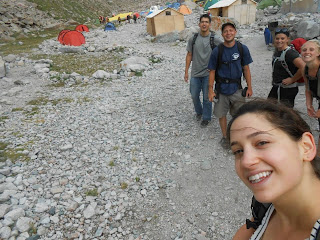
From Issyk-Kul, Max and I headed back to Bishkek. We met up with fellow volunteers Larissa, Nicole and John for a two-day hike into Ala-Archa National Park, a roughly 40-minute drive south of the city. It took us about seven hours to make it up a gorge to Ak Sai Glacier, and was perhaps the most breathtaking and challenging hiking of my life. At the top, we stayed at a [very rustic] lodge and met mountaineers from Germany, Korea, Britain, Japan, Russia….many of whom use the lodge area as a base camp for further hiking. We hiked down the next day, with plans to return and hike further into the park as soon as we can.

After the hike, I spent an extra day bumming around Bishkek. Yesterday, I ate sushi AND Mexican food, saw many other volunteers and even did a bit of clothes shopping. Being in Bishkek is a little disconcerting—often I feel more like I’m in Chicago or Ann Arbor than Kyrgyzstan—but it’s been so wonderful to relax, to see new places and spend time with other volunteers.


In just a few minutes, I’ll begin the journey back to Toktogul. I’m excited to see my host family, to sleep in the same bed (and to sleep in a bed) for more than one night, to get back to work with renewed energy. As I make my way down that winding road to Toktogul, crammed into a taxi between sweaty Kyrgyz ladies, stopping along the way for chai and kimiz (fermented horse milk) and smoke breaks and more kimiz and lord knows what else, I imagine that any doubt about where I am will disappear. It’s been a great trip, but it’s also great to feel that Toktogul is my home, and that it’s time to return there.
Max and Maryn eating ashylan foo
Russian Church in Karakol.
Lake Issyk-Kul
Hot springs at Altin Aryshan outside of Karakol
Our hiking group in Ala Archa!
Me and the ever-so-lovely Larissa.

About halfway up.

The lodge we stayed in at Ak Sai Glacier. 

Surveying the land. 

At the top!


Beautiful Ala Archa National Park.

Add caption

Monday, July 22, 2013

A quick update

Wow, it’s been a long time since I’ve written. Other than a brief medical evacuation to Bishkek (I had a strange hives outbreak. Not to worry—doing fine now), I’ve been in Toktogul. I’m continuing to enjoy this town, my wonderful host family, those mountains that just won’t quit being fantastic. Max and I got a visitor last week—Erik, another volunteer who lives in a village in the northern state of Talas—and we had a great time showing him our town and lovely lake.

In a few days, I’m embarking on a nearly-two-week trip across the country to Issyk-Kul. While I’m pretty attached to my own lake here in Toktogul, Issyk-Kul—which means, literally, “hot lake”—is supposedly the one to see. I’ll be helping another volunteer with a boys’ camp she is running, visiting several other volunteers and doing a few hikes. I’ll be sure to post some updates.


In the meantime, a few photos from the past month here in Toktogul:

The bazaar in Toktogul.

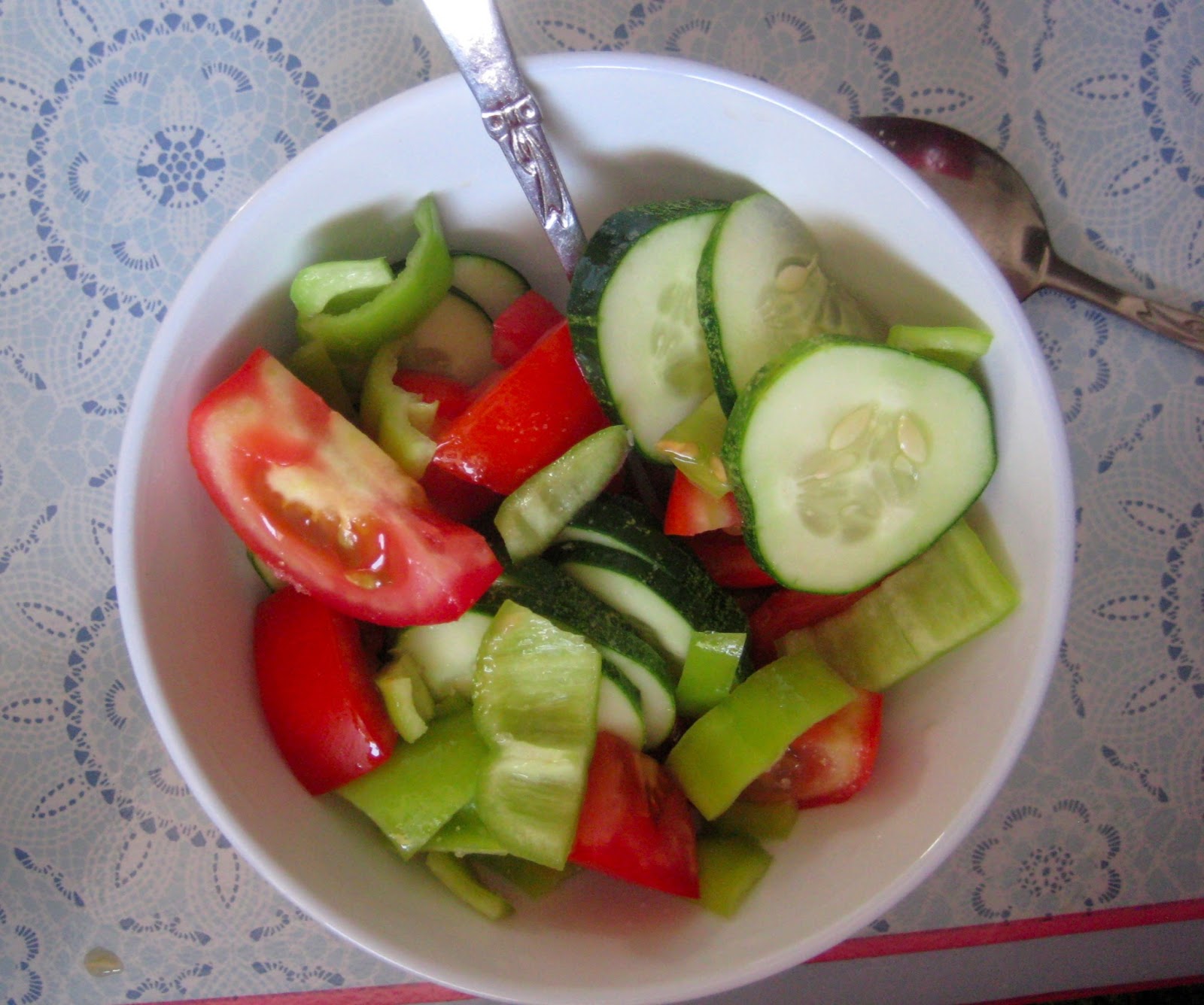
So much wonderful produce right now! I try to eat a lot of food
that looks like THIS. 

My host sister, Jibek, and host mom making apricot jam.

Malika is, of course, helping out. 

So many apricots!
Max (my fellow Toktogul-ian), me and Erik,
another volunteer who visited us from Talas.

En route to the lake.

The boys put together a pretty good picnic.


My lake.


Friday, June 28, 2013

Back in the Midwest.

A few weeks ago, a Kyrgyz friend explained to me that Toktogul is neither in the north of Kyrgyzstan nor the south, east nor west. Its identity, its culture, reflects this position in the middle of the country. I told her that was pretty funny, because both Max (the other volunteer stationed here) and I are from the midwest United States. It seems that, 6460 miles away, we’ve found ourselves in the “midwest” yet again.

I’m coming up on three weeks in the town that will be my home for the next two years. I love it more with each day. According to Wikipedia, Toktogul is a town of about 15,000 people - but I’ve also heard 5,000, so who really knows. I do know that it’s small enough that I can walk from my house on the edge of town to the city center in about 15 minutes. There’s not much traffic, very little trash, and lots of tree-lined streets. We have a bazaar where you can buy anything from a cow’s head to clothes hangers (though not for less than 20 som each, which seems steep to me). There’s a lovely park next to the bazaar, with a “stadium” in which Max and I have been running, and from which you get a great view of the lake.

Toktogul is surrounded by mountains, which means you’re never without a stunning vista, and which also means that weather changes fast. As I write this, the second thunderstorm of the day roars outside my window. In between the two storms, it was sunny and clear. The mountains also mean that the heat and humidity stay relatively low, though it’s been quite warm enough for me recently. I’m excited to see what each new season brings here.

South-ish of town is the lake – or, to be more accurate, the reservoir. It was created by the Soviets in the late 1960s as part of a project to build what is now the largest hydroelectric dam in Central Asia. Apparently, the old city of Toktogul is actually under the water. The lake is giant – at least 40 miles by my guess – and brilliant blue, edged by mountains. I swam in it about a week ago, an experience that cinched my opinion of Toktogul as the best place on earth.

If you haven’t figured it out yet, this blog post is my attempt to convince you to visit me and experience this paradise for yourself. Let’s see – what else? There are apricot and apple trees everywhere, with fresh fruit you can grab as you walk down the street. Toktogul is reputed to have the best meat in Kyrgyzstan (which is saying something), and is famous for its honey. There are fun remnants of Soviet rule, like a hammer-and-sickle statue I came across recently, scattered around town. I live here.

Are you convinced? When are you coming?

There's that lake.

A few blocks from my house.

The walkway next to Lenin Street, the main road in town.

Town square, near the bazaar.

Outside of the city. 


Tuesday, June 18, 2013

I do not live in a yurt.

When I first found out I was going to Kyrgyzstan, I did a lot of Googling. I learned about bushkazi, goat polo, and kimiz, fermented horse milk. I saw pictures of round, ruddy-cheeked Kyrgyz babies and wide, mountain-edged plains. I began to craft a beautiful vision of my life for two years - taking shelter from the elements in my cozy yurt, eating lots of strange sheep meat and maybe riding to work each day on my trusty horse. 

I do not live in a yurt.

About a week ago, I arrived in Toktogul, my permanent site. We pulled up to my new house, and I was surprised to find a brick, two story building. Inside, there was furniture that could have come from Ikea, a toilet, a sizeable TV, a washing machine. This definitely was not the yurt fantasy. It wasn’t even the life I’d been living for two months in the village near Bishkek, where I’d dashed outside to use the outhouse and washed my clothes by hand.

For the first day or two, I felt really uncomfortable with it. This wasn’t what I’d signed up for, wasn’t what I had wanted. I’d joined the Peace Corps, after all.  I was required to live with a family for three months. Maybe after that, I thought to myself, I’d find something more….er….Kyrgyz.

Over the course of the past week, however, I’ve fallen in love. My family consists of a mother, father, a 15-year-old sister, a 14-year-old brother and the wonderful 3-year-old Malika. They have been beyond kind and generous to me, respectful of my space but incredibly inviting. It turns out that my host father, a livestock man by day, built every inch of this house himself. My host mom makes amazing food, and vegetables are a regular thing. I’ve played Frisbee with my host brother, Adilet, and hung out with Jibek, my host sister. Malika and I have had some really excellent tea parties.

To say that this family isn’t Kyrgyz because they have indoor plumbing is to say my family back in the States isn’t American because we don’t eat hot dogs on a daily basis. Expecting to come here and have a quintessentially “Kyrgyz” experience is just as arrogant and foolish as expecting everyone to speak English and know about American culture.

For me, the verdict is still out on the effectiveness of the Peace Corps as an instrument of international development. I will report back in two years. However, in terms of cultural exchange and creating friendships between people of different nations, I think the Peace Corps accomplishes a lot. I have the opportunity to build a relationship with a very wonderful family, and that is far more significant than any romantic life I could imagine for myself on the rugged plains of Kyrgyzstan.


I feel very lucky right now. Toktogul itself is beautiful – so beautiful that I need to devote another whole blog post to describing it. I’ve met many welcoming people so far, including the people I will work with and, most certainly, the people I am living with. I don’t know what the future will hold for me over the next two years. Maybe I’ll spend a night or two in a yurt. But I’m guessing I will be spending the majority of my nights in a two-story brick house in Toktogul.

Malika, age 3. The appeal of stickers, it seems, is universal.
Shortly after this she realized that putting stickers on ME is a lot more
fun than putting them on a piece of paper. 

View from the edge of Toktogul.

The street where I live. 
The view from my bedroom window.
The house, with trusty guard dog Panda on the watch.